
What is presbyopia, why does it develop and what are the best treatments?
Published on · Updated on
Presbyopia is a vision problem affecting millions of people worldwide, particularly from the age of 40–45. If you struggle to focus on nearby objects, such as your mobile phone, computer or a book, you may be experiencing presbyopia. This article explains what the condition is, why it occurs and which treatments are available to improve vision.

1. What is presbyopia?
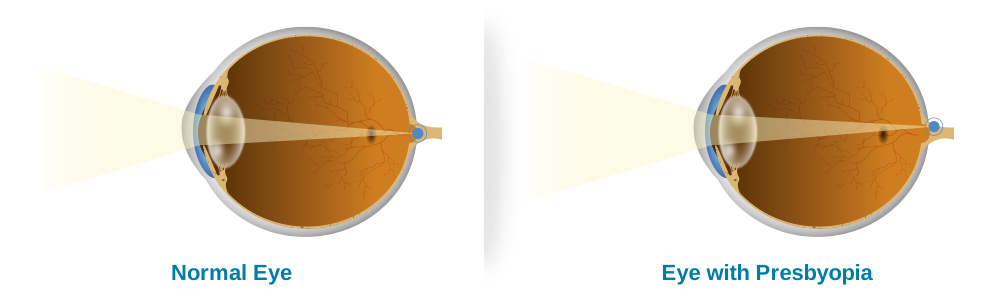
Presbyopia, or age-related long-sightedness, is a vision condition affecting the ability to focus on nearby objects. Unlike other vision problems, such as myopia or hyperopia, it is not caused by the shape of the eye but by the natural ageing of the eye's lens, called the crystalline lens.
2. Why does presbyopia occur?
As we age, the natural lens and ciliary muscles (which change its shape) become harder and less flexible. With the loss of accommodation, the eye cannot focus effectively at short distances. People with presbyopia therefore often need to hold text at arm's length to read it, as the eye focuses better at greater distances.
3. Symptoms of presbyopia
- Difficulty reading close up or needing to hold objects further away to see them clearly.
- Eye strain, particularly after activities such as reading or using a computer.
- Headaches associated with the effort of focusing.
4. Treatments for presbyopia
Several treatment options are available for presbyopia. The most commonly used are:
-
Reading glasses: a simple, inexpensive solution for many people. They do not correct other vision problems; they only help with close-up focus.
-
Varifocal lenses: these glasses offer several prescription strengths in a single lens, allowing vision at different distances. They are an excellent option for people needing both distance and near correction, as they allow clear vision without changing glasses.
-
Multifocal contact lenses: help correct vision at multiple distances and are an option for those who prefer not to wear glasses.
-
Refractive surgery:
- Laser monovision: in this procedure, one eye is adjusted for near vision and the other for distance vision. The brain adapts, allowing functional vision at different distances. It is common in LASIK or PRK surgery.
Intraocular lens: this option involves implanting a lens inside the eye to replace the natural lens, and is particularly useful for people with cataracts and presbyopia. Trifocal lenses allow complete correction of distance, intermediate and near vision.
5. What is the best treatment for presbyopia?
The best option depends on individual factors such as age, lifestyle, eye health and budget. Reading glasses or varifocal lenses are very practical everyday options. Multifocal contact lenses are an appealing alternative for those who prefer not to depend on glasses. For those seeking a permanent solution, refractive surgery and intraocular lens implants are options to consider.
6. Conclusion
Presbyopia is a natural vision condition that comes with ageing. Although it cannot be avoided, there are many options for treating it and continuing to enjoy good vision. If you experience presbyopia symptoms, consult your ophthalmologist to assess which treatment best suits your needs and lifestyle.
See also our information about Presbyopia.
Please follow us on Facebook and Instagram to learn much more about your vision. You can also read our latest articles on the blog, where we discuss different eye conditions, symptoms and treatments.